
Home› Penile Implant Surgery
Penile Implant Surgery in Turkey
A penile implant is the definitive treatment for erectile dysfunction once tablets, injections and vacuum devices have stopped working. Assoc. Prof. Dr. Tuncay Taş performs more than 400 procedures a year in Istanbul, using the same devices and protocols found in the United States and the United Kingdom.
What Is a Penile Implant?
A penile implant, also called a penile prosthesis, is a device placed inside the penis to restore the ability to have an erection. It does not depend on blood flow, nerve signals or medication. The erection is produced mechanically, whenever the man chooses, for as long as he wants.
It is not a last resort in the sense of being an unusual choice. The American Urological Association treats discussing it as a duty rather than an option. Statement 18 of its Erectile Dysfunction Guideline is a Strong Recommendation:
"Men with ED should be informed regarding the treatment option of penile prosthesis implantation, including discussion of benefits and risks and burdens." American Urological Association, Erectile Dysfunction Guideline, Statement 18, Strong Recommendation.
The first hydraulic inflatable device was implanted in 1973 by Dr. F. Brantley Scott at Baylor College of Medicine. Fifty years later the same concept still dominates. The 2025 review "Update on penile prosthesis" in the Asian Journal of Andrology reports that three piece systems hold more than 80 percent of the United States prosthesis market.
How It Works
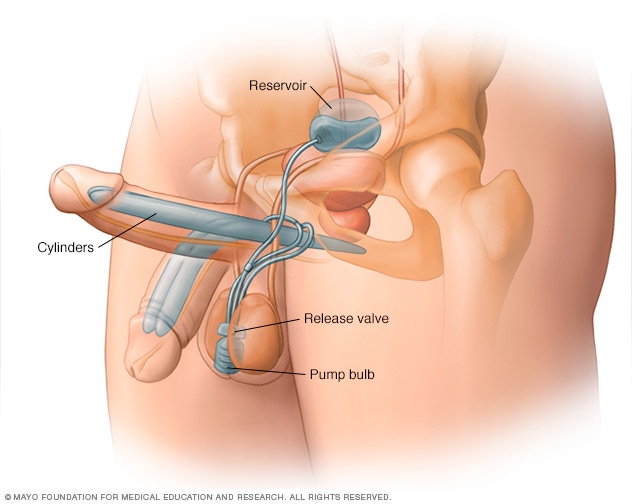
A three piece inflatable prosthesis has three parts:
- Two inflatable cylinders placed inside the penis
- A pump positioned inside the scrotum
- A fluid reservoir placed behind the lower abdominal wall
Squeezing the pump moves fluid from the reservoir into the cylinders and produces a rigid erection. A release valve returns the fluid and the penis becomes soft again. Nothing is visible from the outside in either state, which is why the flaccid photographs of implant patients look entirely ordinary.
Engineering has improved measurably over the years. A parylene coating raised three year revision free survival of the AMS 700 CX from 78.6 percent to 87.4 percent, and the redesigned Ultrex cylinder lifted five year survival from 64.7 percent to 77.7 percent, according to the Asian Journal of Andrology review.
Who Is It For?
An implant is considered when other treatments have failed or cannot be used. The most common routes are diabetes and vascular disease, nerve injury after radical prostatectomy, Peyronie disease with erectile dysfunction, and severe fibrosis after priapism.
The decision is shared rather than handed down. Statement 19 of the AUA guideline is a Clinical Principle: "Men with ED who have decided on penile implantation surgery should be counseled regarding post operative expectations." One rule allows no flexibility. Statement 20 holds that penile prosthetic surgery should not be performed in the presence of systemic, cutaneous or urinary tract infection, which is why every patient is screened before travelling.
Implant Types
Four device families cover almost every case. The right one depends on the severity of the erectile dysfunction, penile anatomy, previous surgery, manual dexterity and what the patient wants from the result.
| Device | How it works | Best suited to |
|---|---|---|
| Three piece inflatable | Cylinders, scrotal pump and abdominal reservoir; the most natural erection and the most natural flaccid state | Most patients; the reference standard for severe erectile dysfunction |
| Two piece inflatable | Cylinders and pump only, with no separate reservoir | Men in whom abdominal surgery makes a reservoir difficult to place |
| Malleable, also called semi rigid | Two bendable rods held in position by hand, with no hydraulics to fail | Limited hand strength or dexterity, and men who prefer the simplest possible mechanism |
| Silicone girth implant | A soft silicone sheath placed under the skin for appearance only | Cosmetic girth enhancement; it does not treat erectile dysfunction |
Boston Scientific AMS 700, Coloplast Titan and Rigicon Infla10 are the inflatable systems used at the clinic. All three fall under FDA product code JCW, a Class III category that requires full premarket approval in the United States, which is the strictest device pathway there is.
Results and Satisfaction
Penile prosthesis surgery has the highest satisfaction figures of any treatment for erectile dysfunction. Pooled series report patient satisfaction of 92 to 98 percent, and the International Society for Sexual Medicine puts it above 95 percent.
"Contemporary Patient Satisfaction Rates for Three Piece Inflatable Penile Prostheses", published in Advances in Urology in 2012, pooled nine clinical series and concluded:
"Patients in general were quite satisfied with their three piece IPPs and restoration of sexual function." Advances in Urology, 2012, pooled review of nine patient satisfaction series, including 96 percent partner satisfaction in one of them.
Durability matches the satisfaction. Between 77.6 and 82.5 percent of AMS 700 CX devices remain revision free at 10 years. For a treatment that replaces a daily tablet with a permanent mechanism, those are the two numbers worth carrying into a consultation.
Before and After
The photographs below are real patients of Dr. Tuncay Taş, published with consent and without identifying detail. What changes between the frames is firmness, not size: the device is sized to the patient's own erectile bodies.


Why Surgeon Volume Matters
In prosthetic urology, who performs the operation changes the outcome more than which device is used. Onyeji and colleagues analysed 14,969 inflatable implant patients in The Journal of Urology in 2017 and found that men treated by surgeons performing 0 to 2 cases a year were 2.5 times more likely to need reoperation for infection than those treated by implanters performing more than 31 cases a year, with a p value below 0.001.
"Patients treated by higher volume implanters are less likely to require reoperation after inflatable penile prosthesis insertion than those treated by lower volume surgeons. This trend appears to be driven by associations between surgeon volume and the risk of prosthesis infection." Onyeji and colleagues, The Journal of Urology, 2017, 14,969 patients.
Dr. Taş performs more than 400 procedures a year, over 12 times that 31 case threshold. In the same dataset, reoperation for any cause was 6.4 percent across a median follow up of 95 months.
Safety and Infection Risk
Infection is the complication that decides whether an implant survives. Current series report prosthesis infection in 0.3 to 2.7 percent of cases, down from 3 to 5 percent in the early 2000s. With no touch technique and antibiotic coated devices the Asian Journal of Andrology review records rates as low as 0.46 percent.
Three things drive that number down: an experienced surgeon, a coated device, and a patient screened for infection before surgery. The third is the reason blood tests and a urine culture are arranged before you travel rather than after you arrive.
The Operation
Surgery is performed under general or spinal anaesthesia and takes 45 to 90 minutes. A single small incision is used, placed either at the base of the penis or in the scrotal fold, and it heals into a fine line that is difficult to find later.
Most patients are discharged within 24 to 48 hours with a written aftercare plan covering wound care, medication, activity limits and the warning signs that should prompt a call.
Recovery
Discomfort is mild and controlled with simple medication. Light walking is encouraged from the first days. Sexual activity is permitted at six weeks with an inflatable prosthesis and at four weeks with a malleable one, and the device is activated at the follow up that marks the end of that period.
Sensation, orgasm and ejaculation are unchanged throughout, because the nerves responsible for them are not touched during the operation.
Treatment in Istanbul
A stay of five to seven days covers the whole pathway. The schedule below is the one an international patient follows, from the airport pickup to the flight home.
| Day | What happens |
|---|---|
| Day 1 | Arrival and assessment. A coordinator meets you at the airport and takes you to your hotel. You then see Dr. Taş: history, examination, blood tests and an ECG. The device is chosen and sizing is discussed with you rather than decided for you. |
| Day 2 | Surgery. Admission is early in the morning. The operation takes 45 to 90 minutes under general or spinal anaesthesia. You move to a private room afterwards and discomfort is controlled with simple medication. |
| Day 3 | Discharge. Dr. Taş reviews the wound in the morning and you return to your hotel with a written aftercare plan covering medication, wound care, activity limits and the warning signs that should prompt a call. |
| Day 4 | Rest. A quiet day at the hotel with short walks encouraged, since gentle movement helps circulation. By this point swelling and discomfort are usually easing. The clinic is reachable by phone and WhatsApp all day. |
| Day 5 | Wound check. You return to the clinic, dressings are removed and healing is confirmed. Many patients receive their medical clearance letter at this visit and are cleared to fly. |
| Day 6 | Optional buffer day. Useful for men facing a long haul flight who would rather not travel the day after a wound check. Transport and pharmacy support remain available. |
| Day 7 | Departure and follow up. Transfer to the airport with a medical summary, digital test results and a follow up schedule. A video review with Dr. Taş takes place before the device is activated at six weeks. |
Surgery takes place in hospitals audited by the Turkish Ministry of Health under its International Health Tourism regulation. Patients from more than 60 countries have been treated under the same brands and protocols used in the United States and the United Kingdom.
Cost
The 2026 Current Urology Reports review "Cost Considerations in Penile Implant Surgery from a Global Perspective" puts average United States facility charges at 25,935 dollars for outpatient surgery and 51,594 dollars for inpatient surgery. An Istanbul package is a fraction of that for the same FDA approved devices.
| Implant | Istanbul | United States | United Kingdom | Europe |
|---|---|---|---|---|
| AMS 700, Boston Scientific inflatable | $9,000 to $12,000 | $25,000 to $35,000 | £18,000 to £22,000 | €20,000 to €28,000 |
| Coloplast Titan, three piece inflatable | $9,000 to $12,000 | $24,000 to $34,000 | £17,500 to £21,500 | €19,500 to €27,000 |
| Rigicon Infla10, inflatable | $6,000 to $11,000 | $20,000 to $28,000 | £14,000 to £18,000 | €16,000 to €22,000 |
| Silicone girth implant, soft prosthesis | $10,000 to $11,000 | $22,000 to $30,000 | £16,000 to £20,000 | €18,000 to €24,000 |
| Malleable, semi rigid rod | $5,000 to $7,000 | $16,000 to $22,000 | £11,000 to £14,000 | €12,000 to €17,000 |
Every figure in the Istanbul column is all inclusive: the device, the surgeon, hospital care, anaesthesia and aftercare. The same brands and the same techniques are used in each region, so the comparison measures the cost of the setting rather than the standard of care.
"Despite its cost effectiveness and high patient satisfaction, penile prosthesis surgery remains underutilized due to increasing costs and inconsistent insurance coverage." Current Urology Reports, 2026.
Health economics work points the same way: over a lifetime, continuing with tablets costs more than surgery once they have stopped working. The figures above are ranges, because the final quotation depends on the device chosen and on what your assessment shows. You can request your own through the contact page.